

+918045132985

Currently it only shows your basic business info. Start adding relevant business details such as description, images and products or services to gain your customers attention by using Boost 360 android app / iOS App / web portal.

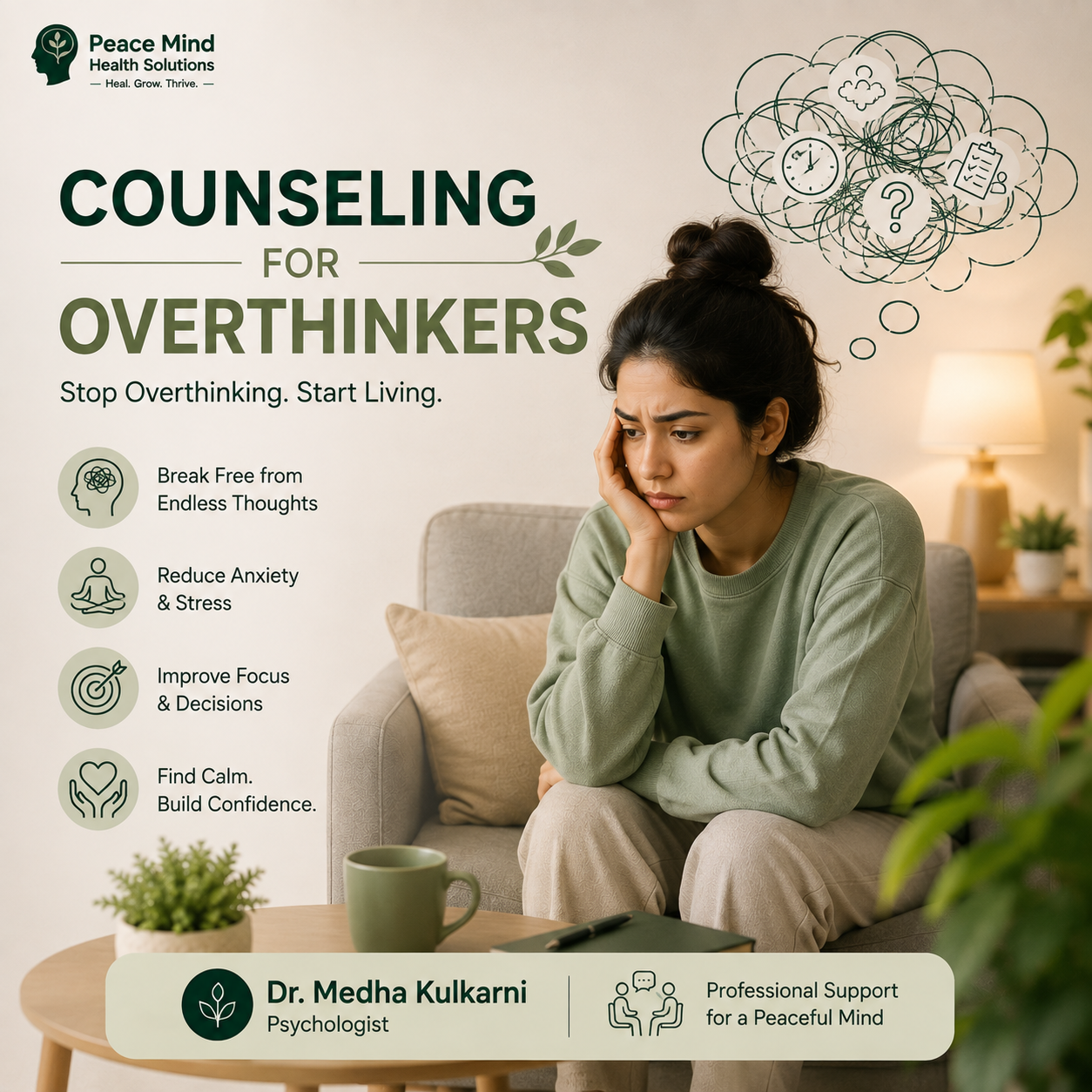
Overthinking can turn small concerns into overwhelming mental loops. Replaying conversations, worrying about the future, imagining worst-case scenarios, or constantly questioning your decisions can leave you mentally exhausted. If overthinking is affecting your sleep, relationships, concentration, work, or daily peace, counseling for overthinkers can provide practical psychological support. At Peace Mind Health Solutions, Dr. Medha Kulkarni (Psychologist) provides compassionate, confidential, and personalized counseling to help individuals understand repetitive thinking patterns, manage anxiety, and develop healthier ways to respond to difficult thoughts. What Is Overthinking? Overthinking involves repeatedly analyzing or worrying about situations without reaching a useful solution. It may focus on past events, current problems, or imagined future situations. For example, you may repeatedly ask yourself: 'Did I say something wrong?' 'What if something goes wrong?' 'What will happen next?' 'Should I have made a different decision?' 'What do they really think about me?' Occasional overthinking is common. However, when repetitive thoughts become difficult to control and start interfering with everyday life, professional support may be beneficial. Signs You May Need Counseling for Overthinking Consider speaking with a psychologist if you frequently experience: Constant worrying Replaying past conversations or mistakes Racing or repetitive thoughts Difficulty making decisions Fear of making the wrong choice Excessive need for reassurance Difficulty relaxing Trouble falling asleep because of thoughts Difficulty concentrating Anxiety about relationships or work Constantly imagining negative outcomes Feeling mentally exhausted The problem isn't simply 'thinking too much.' Persistent overthinking can sometimes be connected with anxiety, stress, low self-confidence, perfectionism, or unresolved emotional concerns. How Counseling Can Help Overthinkers At Peace Mind Health Solutions, Dr. Medha Kulkarni helps individuals understand the patterns that keep repetitive thinking going. Counseling may focus on: Identifying overthinking triggers Recognizing unhelpful thought patterns Managing excessive worry Developing healthier perspectives Building decision-making confidence Learning emotional regulation skills Practicing mindfulness and relaxation techniques Developing practical coping strategies Improving self-awareness Building emotional resilience The approach is personalized according to your concerns, experiences, and goals. Common Reasons People Overthink Overthinking can be influenced by different factors, including: Anxiety and Uncertainty When the future feels unpredictable, the mind may repeatedly search for certainty or reassurance. Fear of Making Mistakes Perfectionism and fear of failure can lead to excessive analysis before making even simple decisions. Relationship Concerns Uncertainty about what someone said, meant, or felt can trigger repeated analysis and reassurance-seeking. Stress and Work Pressure High levels of responsibility can make it difficult to mentally switch off after work or studies. Past Experiences Previous disappointments or difficult experiences can influence how a person interprets current situations. Understanding the underlying pattern is an important part of effective counseling. Therapy Strategies for Overthinking Depending on the individual's needs, psychological counseling may include approaches such as: Cognitive Behavioral Therapy (CBT) techniques Identifying cognitive distortions Mindfulness-based strategies Stress-management techniques Emotional regulation exercises Problem-solving strategies Self-awareness exercises Healthy boundary development The objective isn't to eliminate every thought. It is to develop the ability to recognize unhelpful thought patterns and respond to them more effectively. Why Choose Dr. Medha Kulkarni? At Peace Mind Health Solutions, individuals receive support in a safe, confidential, and non-judgmental environment. Dr. Medha Kulkarni focuses on: Personalized psychological counseling Understanding individual thought patterns Practical coping strategies Compassionate and non-judgmental support Evidence-based psychological techniques Anxiety and stress management Online and in-person counseling options Every person's experience with overthinking is different, so counseling is tailored to individual needs rather than using a one-size-fits-all approach. Benefits of Counseling for Overthinkers Professional counseling can help you: Manage repetitive thoughts more effectively Reduce excessive worrying Improve concentration Make decisions with greater confidence Develop healthier coping mechanisms Improve emotional regulation Sleep and relax more effectively Reduce relationship-related overthinking Handle uncertainty more comfortably Build greater emotional resilience You Don't Have to Believe Every Thought A thought is not always a fact, and thinking about a problem repeatedly doesn't necessarily solve it. With appropriate psychological guidance, you can learn to recognize when your mind is caught in an unproductive loop and develop healthier ways to respond. If overthinking is consuming your time, affecting your relationships, or preventing you from enjoying everyday life, seeking professional support can be a meaningful first step. Book Counseling for Overthinkers Today If you're looking for counseling for overthinkers, don't let repetitive thoughts continue to control your day. Professional psychological support can help you understand your thought patterns, manage anxiety, and develop a calmer and more balanced approach to everyday challenges. Book a consultation with Dr. Medha Kulkarni at Peace Mind Health Solutions today and take the first step toward managing overthinking, building emotional resilience, and creating greater peace of mind.


